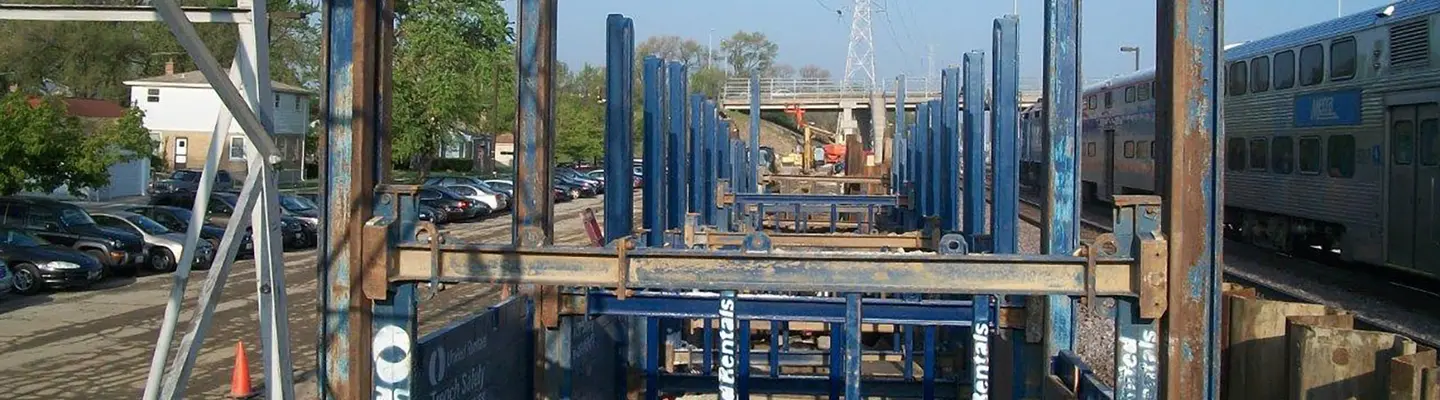
For supporting deep or tight excavations, especially in challenging soil conditions, slide rail systems can be a reliable, cost-effective choice.
Installing underground water and gas lines, tanks, pump stations, bore pits and other structures can be hard enough under favorable conditions. It becomes more challenging when the soil conditions are nasty, the excavation is deep, the geometry is tricky due to existing underground infrastructure or the excavation is adjacent to a building or utility.
In conditions such as these, a slide rail shoring system often offers a faster, more reliable, more cost-effective way to protect workers compared to more conventional methods such as trench boxes, manhole boxes and sloping or benching.
For contractors who haven’t used slide rail shoring before or aren’t sure when it’s an appropriate choice, this guide outlines the basics.
What is a slide rail shoring system?
A slide rail system is a flexible, scalable excavation shoring solution. It uses vertical rails and steel panels that drop into the rails to support the walls of an excavation.
The system is installed from the surface using a dig and push method with standard-size excavating equipment. As more soil is removed, more panels are added. Continuous soil support increases the structural integrity of the excavation and minimizes soil movement. The system is removed by lifting the panels out as the excavation is backfilled.
Most slide rail shoring systems are configured as four-sided pits or straight linear runs, but the modular components can be arranged in a variety of shapes and sizes to fit the excavation geometry.
Slide rail shoring components
The main components of a slide rail excavation system are:
- Vertical corner and linear rails featuring tracks into which steel panels slide
- Steel panels, available in different thicknesses and lengths to handle a variety of project requirements and soil conditions
- Horizontal struts, called strut carts, that press against opposing rails.
Benefits of slide rail shoring
When space is tight, the excavation is deep or complex, the soil conditions are poor or variable, or crossing utilities or adjacent structures are present, slide rail shoring can potentially improve safety, boost productivity and reduce project costs compared to many traditional shoring methods.
Below are some of the benefits of slide rail shoring systems.
- Installed from above, which increases worker safety
- Faster to install and remove than excavation sheeting
- Smaller in footprint than other shoring methods such as benching and sloping
- Reliable in soft, loose, wet and layered soils
- Appropriate for deep excavation shoring (they can better support deeper excavations compared to trench boxes or other less flexible conventional shoring systems)
- Suitable for excavation work adjacent to roads, buildings, rail lines and utilities
- Flexible enough for use around existing underground utilities, tie-ins and structures
- More scalable than trench boxes
- Less costly in terms of materials and labor than shielding and conventional sheeting
- Provide more open space for crews and equipment compared to trench shields
- May reduce restoration costs
Common applications
Slide rail systems are often used in urban projects and other projects with small footprints because they require less space than other options and can be installed using relatively small equipment.
Utilities, municipalities, oil and gas companies and civil and infrastructure contractors often use slide rail excavation systems to install:
- Pipelines
- Water lines and sewer lines
- Underground tanks
- Vaults
- Bridge abutments
- Pump stations
- Lift stations
- Bore pits
- Manholes
- Culverts
In addition, environmental remediation companies may use slide rail trench shoring when making deep, vertical cuts to remove contaminated soil and when installing monitoring and recovery wells, for example.
Slide rail configurations
Modular slide rail systems can be configured in different shapes to suit the jobsite requirements Examples include:
- Pit systems. A pit slide rail system works well for deep, localized excavations. Applications include installing manholes, pump stations, shafts, culverts, bridge footers and cast-in-places structures.
- Tie-back systems. Used for installing tanks, large vaults, bridge abutments, caissons and similar structures, tie-back slide rail systems provide additional lateral support in place of internal bracing to maximize the clear span.
- Sheeting guide slide rail systems. These can replace traditional sheet piling in tight areas with multiple utility crossings, pipe passthroughs, irregular excavations and utility corridors.
- Linear systems. Linear slide rail systems are often used for long, deep and narrow excavations in tight areas. Applications include installing sewer mains, water lines, gas lines, storm drain systems and long pipe runs. They are also used on highway and rail projects.
Slide rail shoring installation
Slide rail shoring installation typically starts with digging pilot holes to install vertical slide rails at the corners and perimeter of the excavation. Once excavation begins, exterior panels are slid into the rails and pushed down until their top is level with the top of the excavation. Interior panels are installed and pushed down until they reach the bottom of the excavation. As the excavation goes deeper, additional interior panels are pushed down to reach final grade.
Because the slide rail system advances with the excavation, the soil is supported at all times.
Slide rail shoring is relatively easy to install, but proper alignment and spacing of components is critical.
Partnering with a knowledgeable slide rail shoring rental partner
Many companies rent slide rail shoring systems, but not all have the knowledge and experience to help customers choose the best excavation support system, properly size slide rail components or configure a slide rail system based on soil conditions and site requirements.
The Trench Safety team at United Rentals can provide insights on the best type of shoring system for a project and educate customers on how to match slide rail equipment to the job.
When an excavation exceeds the manufacturer's tabulated data for the shoring equipment, United Rentals can provide an engineered slide rail shoring design stamped by an in-house Registered Professional Engineer. On request, United Rentals provides an onsite installation advisor to troubleshoot installation issues that may arise and help ensure safe and efficient installation.
 Facebook
 X
 Linkedin
 Email
 Print
 Copy Link
 RSS Feed
