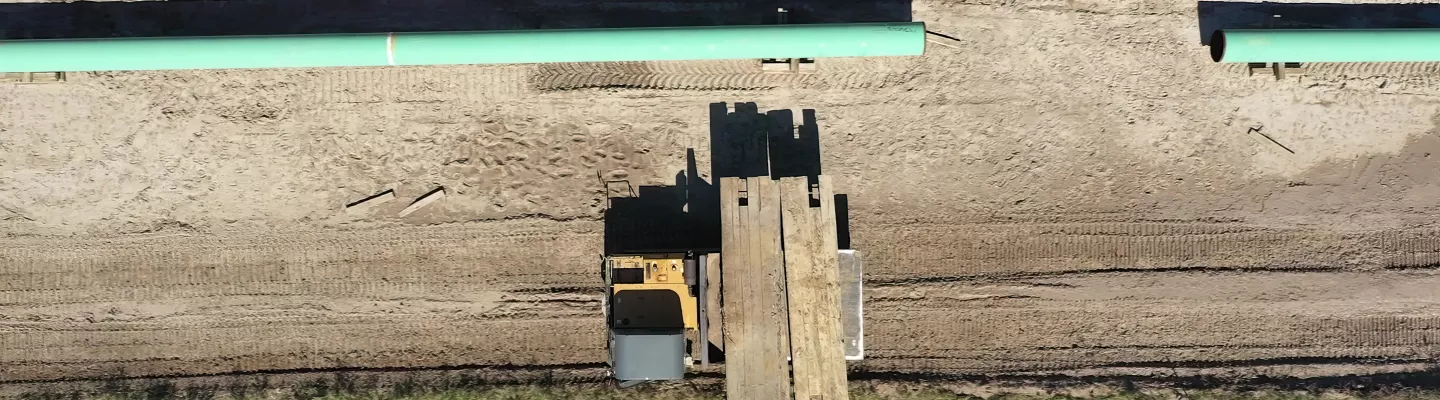
Matching the mat to the job is key to efficiency, safety and cost control.
Pipeline projects break ground across a range of environments, from uncut forests to dense swamps to private rights of way abutting acres of farmland. Ground protection mats allow oil and gas operators and their contractors to access these sites without damaging the land. Acting as temporary roadways or staging areas, pipeline mats provide safe, stable passage and support for heavy machinery such as cranes, excavators, bulldozers and rubber-tired vehicles and workers on foot.
A plethora of choices exists within the world of ground protection mats, and a single project may require multiple styles. Choosing the best mat for the application and terrain can improve safety, keep people and equipment moving efficiently and potentially reduce overspending.
For instance, using heavy timber mats for work inside facilities would be overkill since lighter, cheaper 3-ply mats would do the job. On the other hand, cutting costs by using laminated mats when stronger bridge mats are needed could create safety issues and increase wear and tear on vehicles.
Use the guide below to quickly match mat types to common pipeline needs. Always keep in mind what matters most: terrain, traffic type and load requirements.
Start with your project requirements
Before picking a mat type or mix of mats, confirm these job conditions:
- Equipment and loads: Identify your heaviest equipment and the kinds of forces involved, such as straight travel, turning, braking and lifting.
- Traffic type: Determine if you will use rubber-tired vehicles only, tracked equipment or both, and whether it involves repeated daily traffic or occasional crossings.
- Ground conditions: Assess if you are working on mud, swamp, sand, rocky ground, uneven topography or developed facility surfaces.
- Access need: Define your need for temporary roadways, staging pads, ditch crossings, bridge decking or protected crossings over sensitive areas.
- Project duration and reuse: Consider if you need short-term access or longer-term routes that must hold up to sustained use.
- Environmental and land impact: Note any concerns for minimizing rutting, compaction and disturbance, especially in ecologically sensitive areas.
- Logistics: Review freight constraints, equipment available for offloading and placement and how quickly mats must be installed and removed.
A knowledgeable mat vendor can help you translate these inputs into the right mat style, quantities and delivery plan.
Understanding mat types for pipeline work
18-foot timber mats: Best for most pipeline applications
Sturdy, rugged and resilient, 18-foot timber mats are the most popular pipeline mats. They are used in roughly 90% of projects. Timber mats are typically the best choice for rough, uneven, rocky or muddy terrain and for providing access for heavy machinery such as pipelayers. Their rough surface aids with traction. Constructed from dense hardwood timbers bolted together with steel, timber mats are often the way to go when digging ditches or laying pipelines in undeveloped areas.
Bridge mats: Heavy-duty decking
Bridge mats are used as decking on top of temporary short-span bridges when site access requires crossing over ditches, waterways, oceanfront areas or swamps. Constructed from hardwood, they are strong enough to support the weight of multi-ton vehicles.
3-ply laminated mats: For rubber-tired vehicles
If your temporary roads are traveled by rubber-tired equipment only, 3-ply laminated mats might be your best bet. They are lighter than timber mats, cheaper and easier to maneuver. They work on both level and uneven ground but are not built for rough terrain or recommended for use with heavy equipment.
Light-duty mats: Flexible and cost-effective
For environments that require more durability than 3-ply mats offer but are not rocky or mountainous, light-duty timber mats are an ideal solution. They combine hardwood and pine timbers and weigh roughly half as much as 100% hardwood timber mats, which helps to shave freight costs.
Composite mats: For weight, handling and surface protection
In some pipeline-adjacent areas, such as pedestrian walkways or locations where fast installation and consistent surfaces matter, composite mats can be a practical alternative to timber options. As with any mat, selection should be based on expected loads, traffic type and ground conditions, especially where heavy tracked equipment is involved.
Match mats to common pipeline use cases
Use cases vary across a single right-of-way. These quick pairings help keep your mat plan efficient and defensible:
- For rough, rocky or muddy ROW access for heavy equipment: Start with 18-foot timber mats.
- For work inside facilities or laydown yards with rubber-tired traffic: Consider 3-ply laminated mats to avoid overbuilding.
- For soft ground that is not mountainous or rocky but needs more than 3-ply durability: Consider light-duty mats.
- For crossing ditches or waterways using temporary bridges: Use bridge mats as decking.
- For staging areas and pads: Choose based on the heaviest equipment that will operate on the pad.
Heavy-equipment check: Do not under-spec mats where forces spike
Mat selection is not only about static weight. Pipeline work often creates high-stress moments that can drive the right choice. Intersections, tight turns and stop points may need more robust mats than straight access runs. Where the ground is uneven, mat bridging and stacking may be necessary to maintain a stable surface.
Renting vs. buying ground protection mats
Whether to rent or buy often comes down to duration, reuse frequency, storage capacity and logistics. Renting can be a strong fit when you need flexibility to scale quantities, less burden on storage and maintenance and faster access to the right mix of mat types. Buying can make sense when you have ongoing, high-volume mat needs across multiple projects and the ability to store, manage and maintain an inventory.
H2: FAQ: Pipeline and ground protection mats
Are pipeline mats and ground protection mats the same thing?
"Pipeline mats" often refers to the heavier-duty matting commonly used on pipeline ROW access and construction zones, while "ground protection mats" is a broader category that can include timber, laminated and composite styles.
Can one project use multiple mat types?
Yes. Many pipeline projects use timber mats for heavy access routes and different mats like 3-ply or composite for lighter-use zones or facility work.
What is the biggest cause of mat overspending?
The biggest cause is overbuilding areas that do not need heavy-duty mats or underbuilding high-stress zones and paying later through delays, wear and rework.
 Facebook
 X
 Linkedin
 Email
 Print
 Copy Link
 RSS Feed
